
Featured
Verifying Confinement: A Guide to Shear Wall Reinforcement and Boundary Element Inspection
Shear wall safety relies on inspecting rebar spacing, splice lengths, and crucial boundary element confinement.
Yann Paul · Structural Engineer
Introduction: The Critical Role of Shear Walls
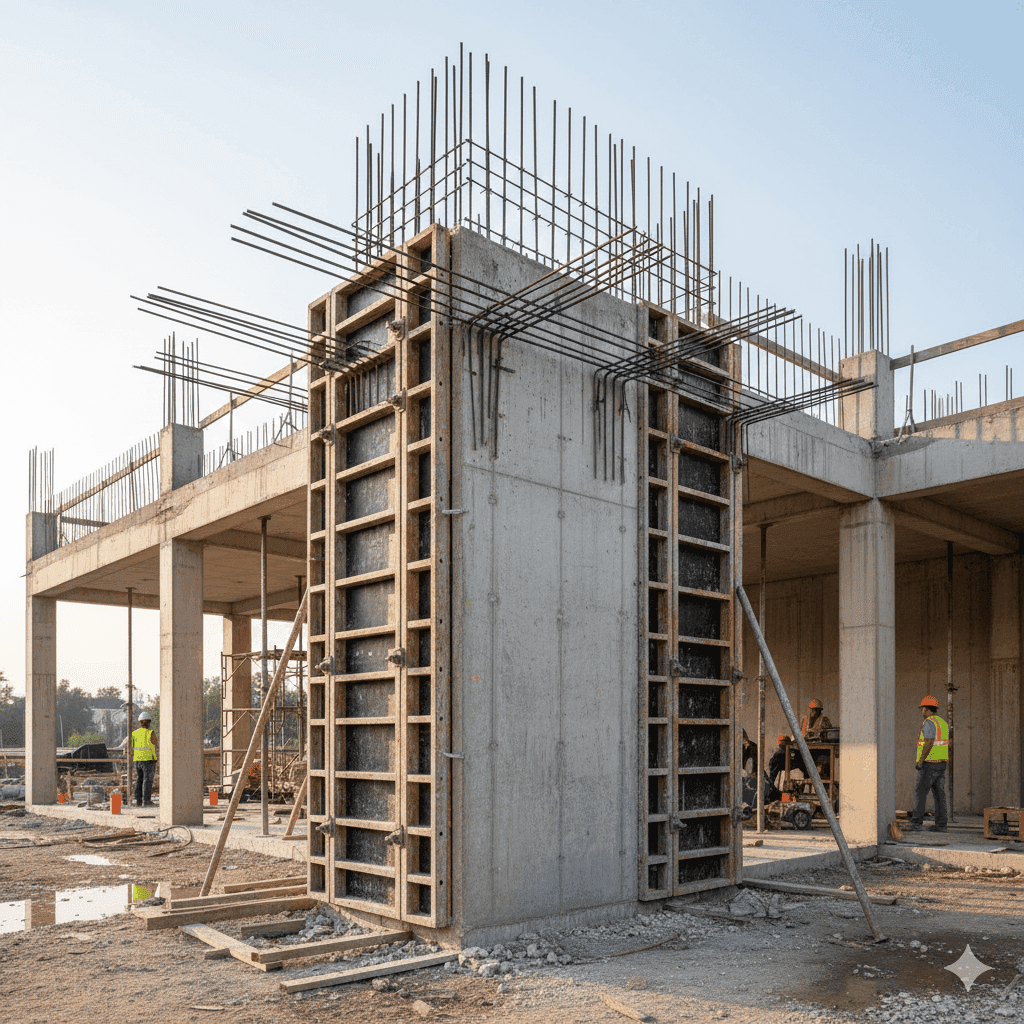
Shear walls are essential structural elements, particularly in regions prone to seismic activity or high winds. Their primary role is to resist lateral forces and transfer them safely to the foundation. However, a shear wall's ability to perform this critical function relies entirely on the proper placement, splicing, and confinement of its internal reinforcing steel (rebar).
Inspection of shear walls is highly detailed and often time-consuming due to the density of steel required, especially within boundary elements—the areas designated to withstand high compressive and tensile forces at the wall's edges. The inspector's diligence here is paramount to ensuring the wall's ductility and ultimate safety.
Section 1: Verifying Reinforcement Placement and Spacing
Before concrete is poured, every bar must be checked for size, type, and location against the approved drawings.
Key Rebar Inspection Requirements:
- Horizontal and Vertical Spacing: Measure the actual spacing of the horizontal (shear) and vertical (flexural) reinforcement. Ensure tolerances comply with local building code (e.g., ACI 318) minimum and maximum limits.
- Splice Lengths and Locations: Verify that rebar splices meet the required development length, particularly for vertical bars. Note the location of all splices; they should avoid high-stress zones unless specifically detailed for that condition.
- Bar Size and Grade: Confirm the diameter and grade of the steel (e.g., Grade 60) match the structural drawings and MTRs (Mill Test Reports).
- Clear Cover: Verify the concrete cover (spacing between the rebar and the form face) is maintained using approved spacers (chairs or bolsters) to prevent corrosion and ensure fire resistance.
Section 2: Inspecting Boundary Elements and Confinement
Boundary elements (often column-like ends of a shear wall) are designed to prevent crushing failure under severe loading. The correct placement of confinement steel in this area is a non-negotiable inspection point.
Required Confinement Verification:
- Boundary Element Dimensions: Confirm the width and depth of the boundary element meet the dimensional requirements specified on the drawings.
- Transverse Reinforcement: Critically inspect the transverse reinforcement (ties or hoops) within the boundary element. Check that the spacing is tight and uniform, often much closer than the general wall reinforcement, as required for seismic/ductile detailing.
- Hook Bending: Verify that the hooks on the tie ends are correctly bent (e.g., 135-degree hooks with required extensions) to ensure they will not open during cyclic loading.
- Lap Lengths in Boundary Zones: Check that any lapped splices falling within the boundary element meet the demanding length requirements for these highly stressed zones.
Section 3: Final Checks and Tolerances
The final structural review before the pour ensures all components are secured and ready to accept the concrete without displacement.
Documentation and Final Checks:
- Rebar Stability: Confirm that the entire rebar cage is securely tied to prevent movement during concrete placement. Displacement of just an inch can severely compromise the design strength.
- Formwork Integrity: Verify formwork bracing is sufficient to withstand the lateral pressure of the wet concrete. Check for any large gaps or openings that could lead to leakage (form blowouts).
- Penetration Coordination: Cross-reference the placement of any blockouts, sleeves, or pipe penetrations. Ensure they do not cut through highly stressed rebar or compromise the confinement of the boundary elements.
- Pre-Pour Clearance: Document that the inspection is complete and the reinforcement is clear to cast. This documentation formally transfers the responsibility for the as-built condition.
Disclaimer: This content is for educational purposes only and does not constitute engineering advice. Always refer to current ACI, AISC, and local building code standards for specific project requirements.